

Microplastic Fluorescence Detection Kit
- Ultrafine Filter Performance Validation

- Rapid Contamination Detection
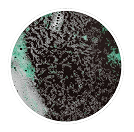
- Water Quality QC

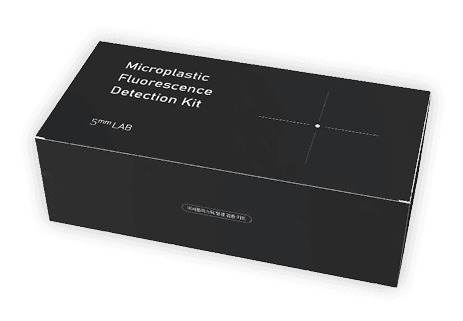
- Nano-scale detection limit
- ~50nm
- Cost per sample reduced
- 76%
- Detection time reduced
- 50%
- Total samples per kit
- 30
Nano-scale detection limit
Cost per sample reduced
Detection time reduced
Total samples per kit
*Compared to conventional outsourced detection methods.
A rapid detection kit for target microplastics in water
Technology
Enzyme-Powered Precision
Enzymatic Degradation
Targeted enzymes break down plastic polymer chains.
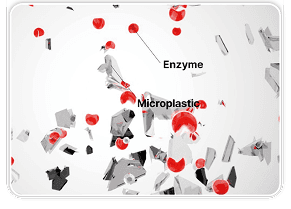
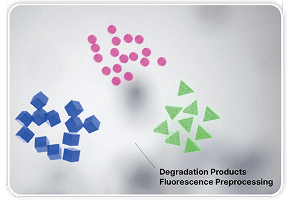
Formation of Degradation Product
Efficiently converts polymers into detectable intermediates.
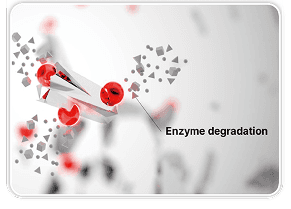
Fluorescence Induction
Chemical transformation into intense fluorescence signals.
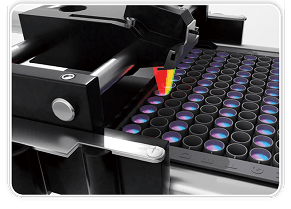
Fluorescence Measurement
Measure fluorescence intensity via microplate reader.
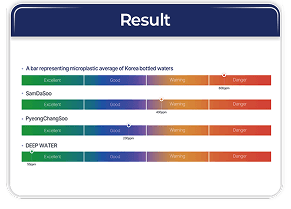
Back-Calculation
Quantify microplastics via standard-curve back-calculation.
Why choose 5mmLAB?
Enzyme-Powered Nano Specificity
Targeted enzymes enable precise polymer detection down to 50 nm.
Standardized Semi-Quantitative Data
Reliable concentration results via standardized calibration curves.
High-Throughput
Analyze multiple samples simultaneously with a rapid protocol.
Optimized In-House Analysis
Eliminate outsourcing delays with a complete in-house workflow.
Streamlined Workflow
5mm® LAB (Fluorescence)
5 hours- 1Sampling
- 2Enzyme Incubation
- 3Fluorescence Detection
- 4Result
µFT-IR (Spectroscopy)
2–3 days
- 1Sampling
- 2Filtering
- 3Spectroscopic Detection
- 4Counting & Distinction
- 5Result
Validated Performance
Performance Comparison — Accuracy vs. Ultra-precision Balance
Tested using reference materials (75–125 µm) at a 10 µg/ml concentration. Validated by K-medi-hub (accredited testing laboratory).
Specification
Target Polymers
DP-KIT-MFD01
Polyester (PET, PBAT, PETG)
DP-KIT-MFD02
Polyamide (PA6, PA66)
Performance
| Result Output | Semi-quantitative concentration (standard-curve based) |
| Detection Limit | Down to 50 nm |
Assay Scale
| Total Samples | 30 samples / kit |
| Run Architecture | 10 samples + 4-point calibration / run |
| Run Capacity | 3 runs / kit |
| Total Reactions | 42 reactions / kit |
| Assay Time | Min. 5 hours / run (depends on sample count) |
Requirements & Logistics
| User-supplied Equipment | Microplate reader, heat modulator |
| Detection Method | Fluorescence detection |
| Storage | Kit: room temp · Enzyme, reagents: 0–4°C |
Kit Components
All necessary consumables for 30 samples (10 samples × 3 runs) are included.
| Standards & Reagents | Reference material · Reagents · Enzyme |
|---|---|
| Consumables | 96-well plates: 2 units/run (6 total) · Reaction tubes: 25 units/run (80 total) · Sampling tubes: 10 units/run (30 total) |

Frequently Asked Questions
How does this microplastic detection kit work?+
Targeted enzymes break down plastic polymer chains, forming a fluorescent degradation product. A microplate reader measures the fluorescence intensity, which is converted into a semi-quantitative concentration using a standard calibration curve. The full workflow, from enzymatic degradation to back-calculation, takes about 5 hours per run.
What equipment is required to use this microplastic test kit?+
You'll need a standard fluorescence microplate reader and a heat modulator for the enzyme incubation step. The kit itself supplies all consumables, including reference material, reagents, enzyme, 96-well plates, reaction tubes, and sampling tubes, for 30 samples across 3 runs.
Which polymers can the kit detect and identify?+
The MFDK is a microplastic identification kit that targets two polymer families: polyester (PET, PBAT, PETG) and polyamide (PA6, PA66), with detection down to approximately 50 nm. Each target polymer family has a dedicated kit variant, DP-KIT-MFD01 for polyester and DP-KIT-MFD02 for polyamide.
What results does the kit provide?+
Results are reported as a semi-quantitative concentration based on a standard calibration curve, not an exact particle count. This is well suited for comparing samples and tracking relative contamination levels; for absolute particle counts or polymers outside the kit's target list, complementary methods such as µFT-IR are still recommended.
Can laboratories in the UK and Germany order the kit?+
Yes, the kit ships internationally, including to the UK and Germany, through our Amazon listing. International orders incur an additional shipping fee at checkout. For bulk orders, custom quotes, or distribution inquiries, laboratories can also contact us directly.
Sample testing & field trials welcome
We welcome researchers and organizations pushing microplastic detection forward.
- Free sample screening
- Field pilot opportunities
- Open to global collaboration
Ships internationally, including the UK and Germany. International orders incur an additional shipping fee at checkout.
Related reading
- Microplastic Water Testing: Basic vs Plus
Explore 5mmTEST water testing, compare Basic and Plus, and learn about microplastic concentration, hardness, pH, sample collection and results.
Read more → - How Our Microplastic Detection Kit Works:
Enzyme-Based Fluorescence for PET, PBAT and PETG
Learn how 5mmLAB uses enzyme-based fluorescence for the detection and semi-quantitative analysis of PET, PBAT and PETG in water samples.
Read more →